Monday, November 3, 2008
MAHATMA GANDHI
Children, there is not a single country in the whole world where the name of Mahatma Gandhi is not known. Do you know why Gandhiji became so famous? It was because he dedicated his whole life to the service of the motherland, and service of humanity. Today, I am going to tell you in brief, the story of Mahatma Gandhi, the father of the Nation, or Bapuji, as he is affectionately called. In the early days our country was made up of a large number of small Princely Kingdoms. Porbandar in Gujarat was one such Princely Kingdom. Gandhiji's father Karamchand Gandhi, popularly known as Kaba, was a Minister there. Kaba Gandhi was an honest, upright man, a strict disciplinarian, and very hot tempered. His wife Putalabai was a extremely religious person. She would not have her meal until she had worshipped the sun. Hence sometimes in the rainy season, she would go hungry for two-three days at a stretch. She was a very loving person, and immensely hard-working. To these parents a son was born on October 2nd, 1869. He was their youngest son. He was called Mohandas. He was our Gandhiji. The strict discipline of his father, the religious bent of mind of his mother, all influenced Gandhiji greatly. He was deeply attached to his parents and brothers. The values of truthfulness, honesty, integrity were instilled in him from the very beginning. As a child he was not very brave. He was mortally afraid of the dark, of ghosts and spirits, and also of snakes and scorpions. At night he would cry in fear. The maid who looked after him scolded him very often. "You should be ashamed of yourself" she would say. "What will you do when you grow up?" She then told him that everytime he was frightened he should take the name of God Rama. Gandhiji took her advice, and gradually he overcome his fear. Soon it was time for him to go to school. As his father was in Rajkot at that time, he attended the school there. Being extremely shy, he did not mix with the other children. Most of the time he kept to himself. In the beginning he did not like some of the subjects that were taught to him, but with encouragement from his teachers he studied them, and began to enjoy them. From then onwards he took his studies very seriously. Mohan was very shy. As soon as the school bell rang, he collected his books and hurried home. Other boys chatted and stopped on the way; some to play, others to eat, but Mohan always went straight home. He was afraid that the boys might stop him and make fun of him. One day, the Inspector of Schools, Mr Giles, came to Mohan's school. He read out five English words to the class and asked the boys to write them down. Mohan wrote four words correctly, but he could not spell the fifth word `Kettle'. Seeing Mohan's hesitation, the teacher made a sign behind the Inspector's back that he should copy the word from his neighbour's slate. But Mohan ignored his signs. The other boys wrote all the five words correctly; Mohan wrote only four. After the Inspector left, the teacher scolded him. "I told you to copy from your neighbour," he said angrily. "Couldn't you even do that correctly?" Every one laughed. As he went home that evening, Mohan was not unhappy. He knew he had done the right thing. What made him sad was that his teacher should have asked him to cheat. As was the custom in those days, when he was about 13-14 years old, he got married. His wife's name was Kasturba (and she was as old as him). It was at this time that Gandhiji fell into bad company and picked up many bad habits. It was because of these bad habits, that unknown to his parents, he was once forced to sell a part of his gold bracelet. However, he soon realised his mistake, and amply repented his sinful behaviour. He decided to make a clean breast of everything to his father, but he lacked the courage to face him. So instead, he wrote a letter to his father, mentioning all the sinful deeds he had done. He gave the letter to his father, and stood by his bedside, his face hanging down in shame. At that time Kaba Gandhi was seriously ill. He felt misreable when he read the letter. Tears rolled down his cheeks, but he did not say a single word to his son. It was too much for Gandhiji to bear. Right then he resolved that he would always lead a truthful and honest life, and throughout his life he stuck to his resolution.

Martin Luther King And Gandhi
Martin Luther King, beloved king of the heart-world, unhorizoned vision of the mind-world, hero-warrior of the vital-world, life-sacrificer of the body-world, to you my aspiration-dedication-life bows.
The Saviour-Son gave humanity the lesson of compassion and forgiveness. India's Mahatma Gandhi, with his message of non-violence, proved to be an excellent student. In America the Absolute Supreme chose you to be His unparalleled student, to love divinely the soul of His creation and to serve unreservedly the body of His creation.
We, the members of the United Nations Meditation Group, bow to you lovingly, devotedly and soulfully.
Sri Chinmoy
29 November 1977
(Tribute to Dr. Martin Luther King at the United Nations. The programme was attended by Mrs. Coretta Scott King.)
Campaign for Home Rule
Gandhi became a leader in a complex struggle, the Indian campaign for home rule Following World War I, in which he played an active part in recruiting campaigns, Gandhi, again advocating Satyagraha, launched his movement of non-violent resistance to Great Britain. When, in 1919, Parliament passed the Rowlatt Acts, giving the Indian colonial authorities emergency powers to deal with so-called revolutionary activities, Satyagraha spread throughout India, gaining millions of followers. A demonstration against the Rowlatt Acts resulted in a massacre of Indians at Amritsar by British soldiers; in 1920, when the British government failed to make amends, Gandhi proclaimed an organized campaign of non-cooperation. Indians in public office resigned, government agencies such as courts of law were boycotted, and Indian children were withdrawn from government schools. Throughout India, streets were blocked by squatting Indians who refused to rise even when beaten by police. Gandhi was arrested, but the British were soon forced to release him.
Economic independence for India, involving the complete boycott of British goods, was made a corollary of Gandhi's Swaraj (from Sanskrit, "self-governing") movement. The economic aspects of the movement were significant, for the exploitation of Indian villagers by British industrialists had resulted in extreme poverty in the country and the virtual destruction of Indian home industries. As a remedy for such poverty, Gandhi advocated revival of cottage industries; he began to use a spinning wheel as a token of the return to the simple village life he preached, and of the renewal of native Indian industries.
Gandhi became the international symbol of a free India. He lived a spiritual and ascetic life of prayer, fasting, and meditation. His union with his wife became, as he himself stated, that of a brother and sister. Refusing earthly possessions, he wore the loincloth and shawl of the lowliest Indian and subsisted on vegetables, fruit juices, and goat's milk. Indians revered him as a saint and began to call him Mahatma (great-souled), a title reserved for the greatest sages. Gandhi's advocacy of nonviolence, known as ahimsa (non-violence), was the expression of a way of life implicit in the Hindu religion. By the Indian practice of nonviolence, Gandhi held, Great Britain too would eventually consider violence useless and would leave India.
The Mahatma's political and spiritual hold on India was so great that the British authorities dared not interfere with him. In 1921 the Indian National Congress, the group that spearheaded the movement for nationhood, gave Gandhi complete executive authority, with the right of naming his own successor. The Indian population, however, could not fully comprehend the unworldly ahimsa. A series of armed revolts against the British broke out, culminating in such violence that Gandhi confessed the failure of the civil-disobedience campaign he had called, and ended it. The British government again seized and imprisoned him in 1922.
After his release from prison in 1924, Gandhi withdrew from active politics and devoted himself to propagating communal unity. Unavoidably, however, he was again drawn into the vortex of the struggle for independence. In 1930 the Mahatma proclaimed a new campaign of civil disobedience, calling upon the Indian population to refuse to pay taxes, particularly the tax on salt. The campaign was a march to the sea, in which thousands of Indians followed Gandhi from Ahmedabad to the Arabian Sea, where they made salt by evaporating sea water. Once more the Indian leader was arrested, but he was released in 1931, halting the campaign after the British made concessions to his demands. In the same year Gandhi represented the Indian National Congress at a conference in London.
Economic independence for India, involving the complete boycott of British goods, was made a corollary of Gandhi's Swaraj (from Sanskrit, "self-governing") movement. The economic aspects of the movement were significant, for the exploitation of Indian villagers by British industrialists had resulted in extreme poverty in the country and the virtual destruction of Indian home industries. As a remedy for such poverty, Gandhi advocated revival of cottage industries; he began to use a spinning wheel as a token of the return to the simple village life he preached, and of the renewal of native Indian industries.
Gandhi became the international symbol of a free India. He lived a spiritual and ascetic life of prayer, fasting, and meditation. His union with his wife became, as he himself stated, that of a brother and sister. Refusing earthly possessions, he wore the loincloth and shawl of the lowliest Indian and subsisted on vegetables, fruit juices, and goat's milk. Indians revered him as a saint and began to call him Mahatma (great-souled), a title reserved for the greatest sages. Gandhi's advocacy of nonviolence, known as ahimsa (non-violence), was the expression of a way of life implicit in the Hindu religion. By the Indian practice of nonviolence, Gandhi held, Great Britain too would eventually consider violence useless and would leave India.
The Mahatma's political and spiritual hold on India was so great that the British authorities dared not interfere with him. In 1921 the Indian National Congress, the group that spearheaded the movement for nationhood, gave Gandhi complete executive authority, with the right of naming his own successor. The Indian population, however, could not fully comprehend the unworldly ahimsa. A series of armed revolts against the British broke out, culminating in such violence that Gandhi confessed the failure of the civil-disobedience campaign he had called, and ended it. The British government again seized and imprisoned him in 1922.
After his release from prison in 1924, Gandhi withdrew from active politics and devoted himself to propagating communal unity. Unavoidably, however, he was again drawn into the vortex of the struggle for independence. In 1930 the Mahatma proclaimed a new campaign of civil disobedience, calling upon the Indian population to refuse to pay taxes, particularly the tax on salt. The campaign was a march to the sea, in which thousands of Indians followed Gandhi from Ahmedabad to the Arabian Sea, where they made salt by evaporating sea water. Once more the Indian leader was arrested, but he was released in 1931, halting the campaign after the British made concessions to his demands. In the same year Gandhi represented the Indian National Congress at a conference in London.
BIOGRAPHY OF MAHATMA GANDHI
Mohandas Karamchand Gandhi was born on October 2, 1869 in Porbandar, India. He became one of the most respected spiritual and political leaders of the 1900's. GandhiJi helped free the Indian people from British rule through nonviolent resistance, and is honored by Indians as the father of the Indian Nation. The Indian people called Gandhiji 'Mahatma', meaning Great Soul. At the age of 13 Gandhi married Kasturba, a girl the same age. Their parents arranged the marriage. The Gandhis had four children. Gandhi studied law in London and returned to India in 1891 to practice. In 1893 he took on a one-year contract to do legal work in South Africa. |
At the time the British controlled South Africa. When he attempted to claim his rights as a British subject he was abused, and soon saw that all Indians suffered similar treatment. Gandhi stayed in South Africa for 21 years working to secure rights for Indian people.
He developed a method of action based upon the principles of courage, nonviolence and truth called Satyagraha. He believed that the way people behave is more important than what they achieve. Satyagraha promoted nonviolence and civil disobedience as the most appropriate methods for obtaining political and social goals. In 1915 Gandhi returned to India. Within 15 years he became the leader of the Indian nationalist movement.
Using the principles of Satyagraha he led the campaign for Indian independence from Britain. Gandhi was arrested many times by the British for his activities in South Africa and India. He believed it was honorable to go to jail for a just cause. Altogether he spent seven years in prison for his political activities.
Bapu in Beliaghata
FIFTY-NINE years ago this week, Mahatma Gandhi moved into a house in Calcutta called the "Haidari Mansion". Despite its name, in August 1947 the place was very run down indeed. As one of Gandhi's companions recalled, it was "a very shabby house without any sort of facility. It was open on all sides — thus being easy of access to outsiders. The doors and windows were broken. There was only one latrine which was used by hundreds of people, including a number of volunteers, policemen and visitors. Every inch of the place was covered with dust. In addition, the rain had made the passages muddy".
Alarming situation
The house was cleaned up, and made somewhat habitable for Gandhi to stay in. He lived there for a little under a month, from August 13 until September 7, 1947. The Haidari Mansion was located in Beliaghata, a locality where Hindus and Muslims had lived cheek-by-jowl in the past, and where they had been butchering each other in the present. For, in the weeks and months leading up to Independence — and Partition — Calcutta had witnessed the most horrific religious rioting. It was to try and stem the bloodshed that Gandhi had come to Beliaghata.
Gandhi's move stopped the violence, temporarily, and both Muslims and Hindus celebrated Independence Day together. After two weeks of peace, the trouble started up again. On August 31, Gandhi began a fast-unto-death. His act shocked and shamed the people of the city, who came around, slowly. On September 4, a group of representative Hindus and Muslims met him with a written promise "that peace and quiet have been restored in Calcutta once again". The undertaking added: "We shall never again allow communal strife in the city. And shall strive unto death to prevent it". The Mahatma called off his fast, and two days later left for Delhi, hoping to restore peace and quiet in that likewise very divided city.
Tranquil ambience
Late last month the present writer visited the Haidari Mansion for the first time. The house was closed, owing to the death earlier that day of the veteran Gandhian Phulrenu Guha. Still, from what I saw, it was clear that the building was very different from what it was when Gandhi first saw it. The windows were intact, the doors new and made up of some rather ornate wood. There were, however, some trees in the compound that must have been there 59 years ago. The place had a tranquil quality about it, as if the spirit of the saint who once briefly lived there still hung around it. (I have experienced this feeling only once before — at the Ashram at Tiruvannamalai, the long-time home of another sage.) There has, I am told, been talk of converting the Haidari Mansion into a proper memorial to Gandhi. It would be a most appropriate location for a centre devoted to inter-faith harmony.
Two great men meet
I had driven to Beliaghata immediately after listening to a rare recording of a speech on Gandhi, delivered in Madison in 1958 by the anthropologist Nirmal Kumar Bose, who, as it happened, had visited Gandhi often at the Haidari Mansion, and written about his fast in Harijan. The Bose recording I had heard at the city's Raj Bhavan, which meant that the route I was now taking had once been taken by the first Indian occupant of that home. This was C. Rajagopalachari. Rajaji shared much with Gandhi — the least of which was four grandchildren. On the 16th, he drove from Raj Bhavan to Beliaghata, to see, speak to, consult, and console with Gandhi. They spent 90 minutes together, discussing matters serious and still more serious. But, as Rajaji's biographer reports, there was also one brilliant flash of humour. The two agreed that it would not do for the Mahatma to stay at Raj Bhavan. An onlooker commented that this was because Gandhi liked to live among ordinary folk. Rajaji answered: "That is why he was put up in the Aga Khan Palace" (where he spent two years in confinement after the Quit India Movement).
Moving account
The 25 days that Gandhi spent in Beliaghata were among the most intensely heroic of his life. They are chronicled, more-or-less faithfully, in the biographies, but have been treated more analytically, and with much insight, in Denis Dalton's Gandhi: Non-Violence in Action. There is also a moving eyewitness account in his grandniece Manu Gandhi's book The Miracle of Calcutta. I shall end with a fragment from this book, which recounts a visit to the Mahatma by the new Ministers of the Bengal Government on Independence Day, August 15. When they sought his blessings, Gandhi told them:
"Today, you have worn on your heads a crown of thorns. The seat of power is a nasty thing. You have to remain ever wakeful on that seat. You have to be more truthful, more non-violent, more humble and more forbearing. You had been put to test during the British regime. But in a way it was no test at all. But now there will be no end to your being tested. Do not fall a prey to the lure of wealth. May God help you! You are there to serve the villages and the poor".
Alarming situation
The house was cleaned up, and made somewhat habitable for Gandhi to stay in. He lived there for a little under a month, from August 13 until September 7, 1947. The Haidari Mansion was located in Beliaghata, a locality where Hindus and Muslims had lived cheek-by-jowl in the past, and where they had been butchering each other in the present. For, in the weeks and months leading up to Independence — and Partition — Calcutta had witnessed the most horrific religious rioting. It was to try and stem the bloodshed that Gandhi had come to Beliaghata.
Gandhi's move stopped the violence, temporarily, and both Muslims and Hindus celebrated Independence Day together. After two weeks of peace, the trouble started up again. On August 31, Gandhi began a fast-unto-death. His act shocked and shamed the people of the city, who came around, slowly. On September 4, a group of representative Hindus and Muslims met him with a written promise "that peace and quiet have been restored in Calcutta once again". The undertaking added: "We shall never again allow communal strife in the city. And shall strive unto death to prevent it". The Mahatma called off his fast, and two days later left for Delhi, hoping to restore peace and quiet in that likewise very divided city.
Tranquil ambience
Late last month the present writer visited the Haidari Mansion for the first time. The house was closed, owing to the death earlier that day of the veteran Gandhian Phulrenu Guha. Still, from what I saw, it was clear that the building was very different from what it was when Gandhi first saw it. The windows were intact, the doors new and made up of some rather ornate wood. There were, however, some trees in the compound that must have been there 59 years ago. The place had a tranquil quality about it, as if the spirit of the saint who once briefly lived there still hung around it. (I have experienced this feeling only once before — at the Ashram at Tiruvannamalai, the long-time home of another sage.) There has, I am told, been talk of converting the Haidari Mansion into a proper memorial to Gandhi. It would be a most appropriate location for a centre devoted to inter-faith harmony.
Two great men meet
I had driven to Beliaghata immediately after listening to a rare recording of a speech on Gandhi, delivered in Madison in 1958 by the anthropologist Nirmal Kumar Bose, who, as it happened, had visited Gandhi often at the Haidari Mansion, and written about his fast in Harijan. The Bose recording I had heard at the city's Raj Bhavan, which meant that the route I was now taking had once been taken by the first Indian occupant of that home. This was C. Rajagopalachari. Rajaji shared much with Gandhi — the least of which was four grandchildren. On the 16th, he drove from Raj Bhavan to Beliaghata, to see, speak to, consult, and console with Gandhi. They spent 90 minutes together, discussing matters serious and still more serious. But, as Rajaji's biographer reports, there was also one brilliant flash of humour. The two agreed that it would not do for the Mahatma to stay at Raj Bhavan. An onlooker commented that this was because Gandhi liked to live among ordinary folk. Rajaji answered: "That is why he was put up in the Aga Khan Palace" (where he spent two years in confinement after the Quit India Movement).
Moving account
The 25 days that Gandhi spent in Beliaghata were among the most intensely heroic of his life. They are chronicled, more-or-less faithfully, in the biographies, but have been treated more analytically, and with much insight, in Denis Dalton's Gandhi: Non-Violence in Action. There is also a moving eyewitness account in his grandniece Manu Gandhi's book The Miracle of Calcutta. I shall end with a fragment from this book, which recounts a visit to the Mahatma by the new Ministers of the Bengal Government on Independence Day, August 15. When they sought his blessings, Gandhi told them:
"Today, you have worn on your heads a crown of thorns. The seat of power is a nasty thing. You have to remain ever wakeful on that seat. You have to be more truthful, more non-violent, more humble and more forbearing. You had been put to test during the British regime. But in a way it was no test at all. But now there will be no end to your being tested. Do not fall a prey to the lure of wealth. May God help you! You are there to serve the villages and the poor".
Dwindling respect for Mahatma Gandhi
while commuting everyday to noida from north delhi, there are a horde of temples that i pass enroute. as a devoted believer, i make it a point to show respect to these roadside gods and goddesses with folded hands. a slight deviation is when i pass rajghat, the samadhi of mahatma gandhi, the man who gave us our freedom from the british, and should have thus been equivalent to any god. not wanting to be an oddity, i decide to follow the general apathy of people towards mahatma gandhi (some people insist on not using the word mahatma). my respect for mahatma gandhi though is intact.
still it will be a food for thought about why mahatma gandhi does not find respect, except in political gatherings and on-the-record conversations.
the greatest damage was done by the popular saying “majboori ka nam mahatma gandhi”. translated to english it makes mahatma gandhi synonymous with an act done involuntarily or under pressure. if i am correct, he got tagged thus after he consented to partition of the country.
mahatma gandhi was never ready for a division or partition of the country. many a times, he warned people of the british tactics of divide and rule. but people were hell bent then. a hindu couldn’t have lived with a muslim residing a block away. same was with muslims. so when the issue started to get out of control, he finally agreed, not wanting there to be bloodshed.
and what these people (those who tell he agreed to partition under pressure or as a favour to muslims) wanted from mahatma gandhi. that he order all muslims to go out of india and also not give them an inch of land anywhere on the earth. that’s baseless.
mahatma gandhi hasn’t found fan following among muslims too. they call him a hindu leader.
he wasn’t a leader of a particular community though. he proved it with words and actions. when he called for a combined action against the british, it was not only from hindus or not only muslims. he wanted to awaken the entire country in his efforts to push british out of india.
and he succeeded. never before gandhi, was any leader able to create a country-wide struggle for freedom. india, although unitedly subservient to the british, didnt think together on ways to get rid of the colonial powers. it was for this reason why the revolt of 1857 failed at the first hand. a few kings and queens fought largely for their interests and the impact of the revolt was hardly visible throughout the country.
gandhiji brought about this awakening among people that they were part of a big country called bharat. the evils that he fought was not only the British; also there were far bigger evils that ruled the minds of people. untouchability was a monster afflicting india. mahatma gandhi said that the dalits or the scheduled castes were harijans or the people of the lord.
and his means of fighting the evil was really very effective. non co-operation, swadesi, satyagraha - who would have thought these could actually force the british out of the country. but just as a homoeopathic medicine works slowly but effectively, his means worked.
but in a country that didn’t spare sita, who was the incarnation of goddess lakshmi, how could we even think of people believing matama gandhi. his tactics were quite good at fighting the outsiders. but when it came to fighting insiders, he was hapless.
so someone, in a fit, killed mahatma gandhi during a prayer meet in 1948. and ever since, people kill the great man every time of the day, by openly flouting his teachings and associating him with evils he fought throughout his life.
Mahatma Gandhi - Mohandas Karamchand Gandhi
Mahatma Gandhi - Mohandas Karamchand Gandhi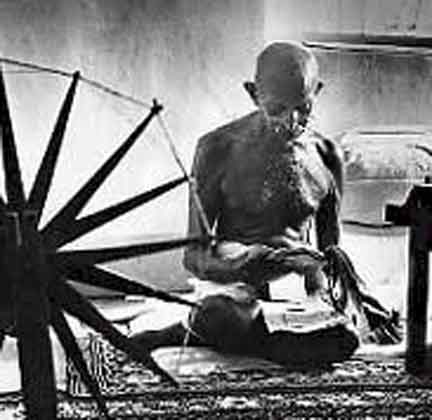
Ex-Devotees Of Sathya Sai Baba Attack India, Indians, Hindus and Mahatma Gandhi
Ex-Devoteeshave been waging concerted and unremitting smear campaigns against Sri Sathya Sai Baba that includes fierce and malicious criticism of India, Indians, Hindus and their religious scriptures.
As a matter of fact, Barry Pittard and Robert Priddy (two of the main spokespersons for the Anti-Sai Movement whose contain numerous defamations, libels and slurs against Sathya Sai Baba, Sai Devotees and Sai Proponents) wrote a joint article entitled “The Sathya Sai Organisation’s Deception And Propaganda Exposed: Part Four” , in which they said about the Ramayana:
“Nor can any intelligent person make good or relevant sense of it in the modern world – it is just a fantastic, impossible concocted story of the ‘Superman’ kind – with ‘monkey-man’ Hanuman lifting and flying aloft with a whole mountain (so Rama could pick out a herb from it!) or jumping across the sea to Sri Lanka. Come on, how can one be so backward intellectually? This may be o.k. for ignorant peasants, but the thinking world must regard it as sheer delusion!”
In addition, Barry Pittard said:
home.hetnet.nl/~ex_baba/engels/articles/barrybetrayal.html
“Since everyone in India suffers from it somehow, the issue of corruption is fairly easy to talk about there. It is the way things are done, including getting non-corrupt matters done.”
Needless to say, Barry Pittard and Robert Priddy (typical white westerners who suffer from the aposate syndrome) have bashed & trashed everyone in India as being “corrupt” and that Mahatma Gandhi, scholars, sages, gurus and millions of Hindus are “backward intellectually” “ignorant peasants” who believe in the Ramayana (which they consider to be “sheer delusion” and an “impossible concocted story of the ‘Superman’ kind”).
In an effort to do damage, control, Barry Pittard recently wrote a blogged article in which he praised Mahatma Gandhi, various religions and India. Hold on! What happened to Ex-Devotee’s claims that everyone in India suffers from corruption that Hindu Scriptures are “impossible concocted stories of the ‘Superman’ kind” and “sheer delusion” that are believed by “backward intellectually” “ignorant peasants”?
To Date: Neither Barry Pittard nor Robert Priddy have issued a public apology for their malicious attacks against India, Indians, Hindus and their scriptures. Nor have they retracted the articles or quotes in question. Consequently, it is to be concluded that Ex-Devotees praise of Mahatma Gandhi, various religions and India is hypocritical and an act of blatant deception.
There is a tremendous amount of information on the internet about Mahatma Gandhi (Mohandas Karamchand Gandhi) and his ardent belief in the Ramayana, the Bhagavad Gita and other sacred texts associated with Hinduism.
Mahatma Gandhi TimeLine:
1869: Mohandas Karamchand Gandhi born in Porbandar in Gujarat.
1893: Gandhi leaves for Johannesburg for practicing law and is thrown out of a first class bogie because he is colored.
1906: Mohandas K. Gandhi, 37, speaks at a mass meeting in the Empire Theater, Johannesburg on September 11 and launches a campaign of nonviolent resistance (satyagraha) to protest discrimination against Indians. The British Government had just invalidated the Indian Marriage.
1913: Mohandas Gandhi in Transvaal, South Africa leads 2,500 Indians into the in defiance of a law, they are violently arrested, Gandhi refuses to pay a fine, he is jailed, his supporters demonstrate. On November 25, and Natal police fire into the crowd, killing two, injuring 20.
1914: Mohandas Gandhi returns to India at age 45 after 21 years of practicing law in South Africa where he organized a campaign of “passive resistance” to protest his mistreatment by whites for his defense of Asian immigrants. He attracts wide attention in India by conducting a fast –the first of 14 that he will stage as political demonstrations and that will inaugurate the idea of the political fasting.
1930: A civil disobedience campaign against the British in India begins March 12. The All-India Trade Congress has empowered Gandhi to begin the demonstrations (see 1914). Called Mahatma for the past decade, Gandhi leads a 165-mile march to the Gujarat coast of the Arabian Sea and produces salt by evaporation of sea water in violation of the law as a gesture of defiance against the British monopoly in salt production
1932: Gandhi begins a “fast unto death” to protest the British government’s treatment of India’s lowest caste “untouchables” whom Gandhi calls Harijans — “God’s children.” Gandhi’s campaign of civil disobedience has brought rioting and has landed him in prison, but he persists in his demands for social reform, he urges a new boycott of British goods, and after 6 days of fasting obtains a pact that improves the status of the “untouchables” (Dalits)
1947: India becomes free from 200 years of British Rule. A major victory for Gandhian principles and non-violence in general.
1948: Gandhi is assassinated by Nathuram Godse, a Hindu fanatic at a prayer meeting
Mahatma Gandhi Quotes On Hinduism & The Gita:
“I call myself a Sanatani Hindu, because I believe in the Vedas, the Upanishads, the Puranas, and all that goes by the name of Hindu scripture, and therefore in avataras and rebirth; I believe in the varnashrama dharma in a sense, in my opinion strictly Vedic but not in its presently popular crude sense; I believe in the protection of cow … I do not disbelieve in murti puja.” (Mahatma Gandhi - Young India: June 10, 1921)
“Hinduism as I know it entirely satisfies my soul, fills my whole being … When doubts haunt me, when disappointments stare me in the face, and when I see not one ray of light on the horizon, I turn to the Bhagavad Gita, and find a verse to comfort me; and I immediately begin to smile in the midst of overwhelming sorrow. My life has been full of tragedies and if they have not left any visible and indelible effect on me, I owe it to the teachings of the Bhagavad Gita.” (Mahatma Gandhi - Young India: June 8, 1925)
The Story Of My Experiments With Truth
By Mahatma Gandhi“What, however, left a deep impression on me was the reading of the Ramayana before my father. During part of his illness my father was in Porbandar. There every evening he used to listen to the Ramayana.”
Select Quotes About Mahatma Gandhiji:
Mahatma Gandhi (Book)
by Sankar Ghose
(Chapter 1: Kathiawar’s Ambitious Boy - page 9)“In later life, Gandhi regarded Ramayana of Tulsidasa as the greatest book in devotional literature and repition of Ramnama as an infallible method of curing one of all kinds of doubts and despondency.”
Priyaranjan Das Munshi’s Mahatma Gandhi!
By V. Sundaram
News Today“Mahatma Gandhi was a great devotee of Lord Rama and Lord Krishna. He worshipped the Ramayana and the Bhagavad Gita. Rama Nama and Ram Rajya were for Gandhi synonymous terms. Addressing a prayer meeting in New Delhi on 25 May, 1946, Mahatma Gandhi said: ‘Rama Nama should come from the heart. In that event, Rama Nama could become an effective remedy against all ailments. A man who believes in Rama Nama would not make a fetish of the body but would regard it as a means of serving God. And for making it into a fit instrument for that purpose, Rama Nama is the sovereign means. To install Rama Nama in the heart requires infinite patience. It might even take ages. But the effort is worthwhile. Rama Nama cannot come from the heart unless one has cultivated the virtues of truth, honesty and purity within and without.’
Therefore, Ex-Devotees of Sathya Sai Baba (all white Westerners) have directly and unequivocally berated Mahatma Gandhi (a firm believer in the Ramayana) and millions of Hindus as “backward intellectually” “ignorant peasants” who are universally “corrupt” and who believe in scriptures that should be regarded as “sheer delusion” and “impossible concocted stories of the ‘Superman’ kind”.
Subscribe to:
Posts (Atom)